Book Review: Saving Francesca by Melina Marchetta

Saving FrancescaSaving Francesca by Melina Marchetta

My rating: ★★★★★

I don’t remember the last time anyone looked me in the eye to speak to me. I’m frightened to look at myself in the mirror because maybe nothing’s there.

I miss the Stella girls telling me what I am. That I’m sweet and placid and accommodating and loyal and nonthreatening and good to have around. And Mia. I want her to say, “Frankie, you’re silly, you’re lazy, you’re talented, you’re passionate, you’re restrained, you’re blossoming, you’re contrary.”

I want to be an adjective again.
But I’m a noun.
A nothing. A nobody. A no one.

If I could admit to having read a shelf full of Melina Marchetta books, then I would happily name her as my new favorite author. That’s how confident I am in her writing, because after reading her second published novel, Saving Francesca, it’s nearly impossible to imagine any one of her books disappointing me. Saving Francesca is a charmer, and an addicting one at that. Not since my love affair with Rachel Hartman’s Seraphina, and books like Between Shades of Gray, have I felt so drawn to a character that I sacrifice an entire night of sleep. With Marchetta’s novel, however, it’s not merely the main character that hooks me into the story. Just like the aforementioned titles, it’s everything these pages offer. It’s the characters, their relationships and stories, and the palpable world they live in.

Lucky Francesca Spinelli, for she is one of thirty girls attending St. Sebastian’s—only Francesca and her fellow female peers aren’t so lucky. Formerly an all-boys school, St. Sebastian’s has only recently opened as co-ed. What might appear as a paradise for teenage girls is anything but, as Sebastian’s becomes a breeding ground for sexism. The girls, if not ignored, are treated like inferiors and often seen as dolled-up eye-candy. The boys are far from suave, romanticized sex gods, but rather offensive with only a few male students who show redeeming qualities. A lonely, cruel place, Francesca must feel that Sebastian’s is a punishing institution worthy to be deemed a nightmare.

As Francesca’s old St. Stella’s clique attend a different school, she feels her closest friends slipping away. But were they ever her friends when they discourage the very essence that makes Francesca likeable? If they never call or invite her out? Hanging around such a scrutinizing bunch didn’t exactly ring Francesca dry of her buoyant personality, but she did bury it beneath an instinct to blend in. It’s a misfortunate characteristic to learn, and feeling friendless and miserable and confused over her mother’s sudden depression doesn’t make life at Sebastian’s easier.

“Tell me the story about when I almost drowned?” I ask her, so then she can be the hero and it’ll make her feel better. But she says nothing and I switch on the television and I pretend that what we’re watching is funny. It’s a sitcom about a family, two kids, a mum, and a dad. Their idea of tension is an argument about who gets the cottage out back. At the end, everyone’s happy because that’s what happens in television land. Things get solved in thirty minutes.

God, I want to live there.

But splitting up with “the Stella girls” is one of the best things that can happen to Francesca, because who needs judgmental “friends”? Slowly and surely, Francesca’s old friends are replaced by new ones: Tara Finke, the feminist, or simply the ‘Speak Your Mind About Anything-ist’; Justine Kalinsky, the solid and dependable accordion geek; and Siobhan Sullivan, reportedly “the Slut of St. Stella’s” and Francesca’s long-time-ago best friend. Then, by some shock and surprise, even a few boys turn up: Jimmy Hailler, who wouldn’t want to be anywhere else than at a Spinelli dinner; Thomas Mackee, always plugged into his Discman; and finally Will Trombal, Francesca’s giant crush.

“Forget it,” he says, walking away angrily.

“And what’s the name for people who kiss other people when they’ve got a girlfriend?”

He stops and turns around, looking me straight in the eye.

“A weak, spineless prick.”

Oh great, I think. Take the right to call you names right off me, you… weak, spineless prick.

Marchetta’s strength resides in her characters and her ability to write life. Her characters are perfect in the ways they are imperfect, not only likeable but relatable. They feel as real as you or me, because I believe—without a moment’s hesitation—that somewhere out there in the world is a Francesca Spinelli, a Will Trombal, and a Tara Finke and Thomas Mackee. Marchetta writes with depth, lighting up every crevice of their personalities. These are fully rounded characters, each and every one. Not even secondary characters can avoid this writer’s prowess—even if they are mentioned once never to be heard from again. As real as I believe these characters to be, however, I also recognize their own strengths.

I know from experience that high school isn’t easy, and it can be a challenging place to tackle. Feeling alone and unattached, having no group to belong to, doesn’t make it any more inspiring. Throw depression into the mix, and it all as well might seem hopeless. Depression itself is a bleak situation of its own, affecting not only the person who suffers from it, but those around the depressed individual. When depression strikes Francesca’s mother, it nearly rips the Spinelli family apart, but Francesca is stronger than she thinks—and so is her mother.

Saving Francesca isn’t a book about ideals, as the characters and their problems are far from that. What this book does have is sensibility and a resounding support system that fills me with envy. As Francesca’s mismatched group comes to accept each other, they display resourcefulness to help themselves and support their friends. They accept each other, flaws and all, with such genuine care and love that I find it difficult not to feel affected.

“I was born seventeen years ago,” I tell him. “Do you think people have noticed that I’m around?”

“I notice when you’re not. Does that count?”

Saving Francesca has more to it than the typical young adult contemporary novel, and I believe this has much to do with how realistically Marchetta writes from the teenage perspective. This is a book about moms and daughters, platonic love, and finding your spot among a crazy, intimidating herd. This is Francesca Spinelli’s story toward finding her own strength—strength to save and free herself, to let go of inhibitions—just as much as it is about personal growth. Equally heart-wrenching as it is heart-warming, Saving Francesca is peppered in pure, sincere emotion with delightful humor. It’s a book that will make you laugh and spill tears, and I am betting that it will be a book you’ll want to read all over again.

A great feeling comes over me. Because for a moment, I kind of like who I am.

Library Loot #11

  • Library LootLibrary Loot is a weekly event co-hosted by Claire from The Captive Reader and Marg from The Adventures of an Intrepid Reader that encourages bloggers to share the books they’ve checked out from the library. If you’d like to participate, just write up your post — feel free to steal the button — and link it using the Mr. Linky any time during the week. And of course check out what other participants are getting from their libraries.

The weather went from hot to drafty to… cold and rainy. With the nice weather went my brain, apparently, because I’m not only in a “school slump” but a reviewing slump. Or maybe it’s a case of writer’s block. Either way, I figure the best way to combat any pressure I feel to review certain books is to read books I don’t intend to review–or have already reviewed (like Seraphina!). I have two ARCS that need reviews written up before June 1st–one of which I’ll post next month–as well as a research paper due June 4th that I should be working on. Hardly a full plate, but with spring comes longer days and shorter tolerance levels.

Basically, I feel cramped. So I went to the library.

LL 1

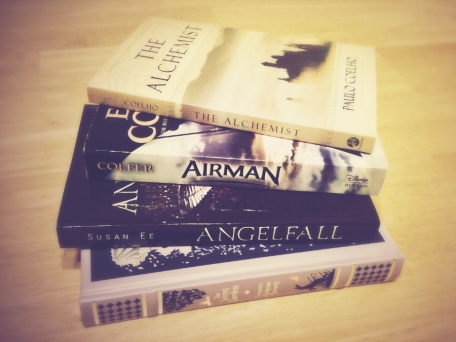
These are for my research paper–a large part to my medical anthropology grade–which I feel an urgent need to start. (See, I didn’t stop by the library just to peruse shelves and grab a few recreational reads!) I chose to focus on HIV/AIDS in the U.S. during the 1980s — I may have stubbed myself on this, because I’m almost afraid I’ll turn up with little information that won’t churn out a five-page, single-spaced essay. Published field research appears scant, and it seems there are more sources that focus on AIDS patients and not ‘behind the scenes’ politics of the medical community.

My topic does, however, give me an excuse to re-watch And the Band Played On. I watched this back in February as part of my HIV/AIDS education for my CNA class. The book looks intimidating, though I’m sure it’s highly resourceful, but I do recommend the movie.

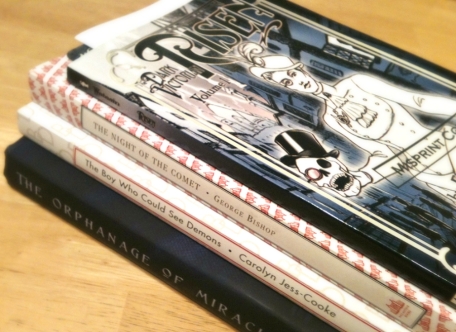
I also went wandering in the back of the library and picked up several books on whim:

LL 2

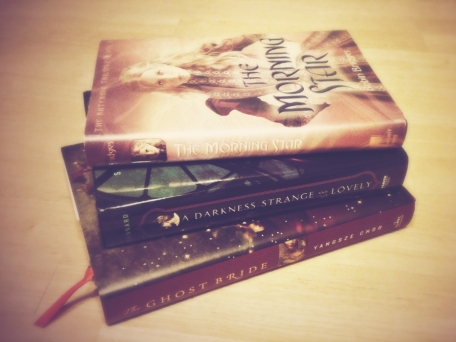
One book I am anticipating the release of this summer is The Ghost Bride by Yangsze Choo, and I dumped my excitement for it on Ryan’s Water Ghosts. Of course, the only similarities these two books seem to share are 1) ghosts and 2) Chinese characters. While I’m waiting on Choo’s book to hit stores, however, Water Ghosts sounds interesting enough. I’ve also heard a lot about The Brothers Sisters –hopefully I’ll have time for it! I’m wary to approach Connolly’s book, as I did read The Book of Lost Things last year. While I enjoyed the story, it did feel like the plot jumped from here to there without bearing significance on most of the main character’s interactions. I’m hoping The Gates is an improvement in that regard.

That’s all the library loot from me this week. In two week’s time, I can only hope that I’ve managed a decent research paper and have two ARC reviews out of my hair!

Tell me which book’s you’ve snagged from the library lately. How about summer books you’re looking forward to?

Raya
xo

Top Ten Tuesday #11

Top Ten Tuesday is an original weekly meme hosted by The Broke and the Bookish. Click here to read more and join!

Top Ten Tuesday is an original weekly meme hosted by The Broke and the Bookish. Click here to read more and join!

This Top Ten Tuesday prompt is a fun one, I think: favorite covers of books I’ve read*, also known as covergasms. It’s preferable if a story proves as wondrous as its cover art, but even if I loathe a book, you can find me drooling over its eye-candy front. Here are a mere ten books (with extra notable mentions) whose fancy covers caught my eye:

Can a person ever go wrong when it comes to a Barnes & Noble cover? I love their paperbacks, even. My Grimms’ Fairy Tales copy is part of B&N’s leatherbound collection, gifted by an old friend, and I’ve never stopped adoring the cover. My one complaint is that the page edges are frosted in a sparkling gold, which–as I learned the sad way–easily brushes off.

The cover to Connolly’s The Book of Lost Things, although without golden pages, reminds me of a few B&N hardbacks: it’s simple but elegant-looking. Seraphina is all-around love, however, as I equally adore Hartman’s writing as I do the cover. The sepia provides a medieval appearance with a flavor of fantastic (dragons!). It does have a few rusty smudges, which is part of the artwork — though I have a terrible urge to wipe them off!

Mr. Fox

4. Mr. Fox by Helen Oyeyemi

I read the edition on the left-hand side, although I fancy both covers. The cover on the right is very Old Hollywood-esque, by my favorite, however, is from the copy I read. I remember spotting it in the library and deciding to grab it on whim after reading the jacket blurb. Although Oyeyemi presents a rather confusing storyline, I enjoyed each tale, which I think the cover represents well.

books 5 - 6 TTT

5. Dr. Bird’s Advice for Sad Poets by Evan Roskos
6. How to Say Goodbye in Robot by Natalie Standiford

These two books are triple-threats: simple cover designs that scream awesome, quirky titles, and great writing. While I’m attracted to the covers to both of these books, it’s the titles that I gravitated toward. The titles are entirely their own, possessing a unique quality shared by the stories that are bound between the covers. I don’t have the words for the cover of How to Say Goodbye in Robot other than “covergasmic love” and “I’m sure more boys would read this if the cover wasn’t pink!” Rosko’s cover, on the other hand, feels fresh. Considering that I find the story quite different from others like it, I think the cover suits the story.

The Rabbits

7. The Rabbits by John Marsden & Shaun Tan

I am a huge fan of Shaun Tan’s art in general, but The Rabbits–among a couple of other Shaun Tan books–is what I consider one of his best works. As art and text combine to communicate a powerful message, The Rabbits tells an allegoric tale about colonization. The cover does a wonderful job in revealing the story’s tense atmosphere, and–of course–it’s another showcase of Shaun Tan’s genius.

Jelly Roll

8. Jelly Roll: A Blues by Kevin Young

Jelly Roll: A Blues has remained near the top of my “books with awesome covers” list since I first discovered it in 2011. The faded wash and phonograph offer a subtle quiet, but there is also a jaunty, fun-hearted feeling that jumps at the reader. It’s a modernized old soul, very “blues-y,” equipped with inventive language that knows how to lament and praise. With a complementary color scheme to boot, I don’t think you can ask for a better cover.

books 9 - 10 TTT

9. The End of the Alphabet by C.S. Richardson
10. The Merchant & the Alchemist’s Gate by Ted Chiang

The End of the Alphabet and The Merchant & the Alchemist’s Gate both have a Saharan or Middle Eastern feel to their covers, which initially attracted me. Covers that flaunt their fancy designs without superfluous detail will always win my adoration, but I appreciate artwork that feels more simple yet has a mighty voice. The End of the Alphabet is eye-pleasing, although the story didn’t take me where I had hoped it would based on the cover. Chiang’s novella, however, brought me everywhere I’d hoped and then some — something that I feel the cover does well in preparing prospective readers for.

>>Notable Mentions:

TTT nb 1

TTT nb 2

*My list would be endless if I could include books sitting on my TBR list!

What are some of your favorite book covers? Comment below or link me to your TTT post — I’d love to know!

ARC Book Review: Peregrine Harker & the Black Death by Luke Hollands

Peregrine Harker and the Black DeathPeregrine Harker & The Black Death by Luke Hollands
Release date: June 3rd, 2013
e-book ISBN: 9781907230493
My rating: ★★

*This is a review of an uncorrected proof, and quotes/excerpts may therefore differ from the final copy.

One glance at the ratings I have given books since January tells you that I’m either a stingy reader or 2013 is not my year for good books. I don’t seek out books I know I won’t enjoy, because reading a book I dislike is anything but pleasant. It’s frustrating, and it robs me the experience of getting lost in the wonder of someone’s fantastical creation. I don’t find myself absorbed into a character’s life, devouring pages at rapid pace and oblivious to the world around me. No, I find that I’m painfully aware of my surroundings, and even more aware of the book in front me. I’m aware of the regret I feel and the restlessness nearly bursting out, wanting to finish this story as soon as possible and move on. Preferably, I will go on to meet a better book. A book that I’ll adore. I want to read a book that will have me so entrenched that I won’t realize how swiftly I’m plowing through it.

It had been my hope that Peregrine Harker & the Black Death would be that book: a beacon of dazzling promise over an ocean full of disappointment and flimsy plotlines. Instead, Peregrine Harker is another character I’m happy to forget and have since shoved overboard into murky water. It’s not that Luke Hollands’ story is an especially terrible catastrophe, but it is nothing near what I had hoped it would be. At a surface glance, Peregrine Harker & the Black Death promises nothing short of a light-hearted, adventurous novel where danger threatens to jump out at every turn. When I first discovered Hollands’ book, I swore it to be a likable escapade pinched in good fun. For all I know, that might have been Hollands’ intent when he set out to write Peregrine’s adventure, because it sounds exciting:

It’s the year 1908, and expert tall-tale journalist, Peregrine Harker, finds himself in a squeeze: get to the bottom of the spike in tea prices and report the truth or wave his job goodbye. What ensues, however, is a tall tale of its own, beginning as a simple job that soon takes a risky turn into investigative journalism. It’s a story filled with murder, explosions, hot pursuits, spies, and most of all: betrayal and revenge. When Peregrine is sent to meet with tea trader Sir Magnus Clayton, he instantly—and by accident—becomes mixed up in a mystery that goes beyond the cost of tea. After discovering two dead bodies, it becomes apparent that The Black Death has Peregrine Harker pinned as their new target. Rescued by Clayton’s butler, Mr. Woolf, Peregrine swears to help Clayton demystify the perplexing tea issue. Warned not to trust Clayton, however, the tea trader may not appear to be who he says he is. When Clayton’s leads direct Harker straight into unfriendly territory, who is left to trust when punches and lies creep out from all corners?

The exaggeration over the rising price of tea, I must admit, bothers me. This isn’t any Boston Tea Party, so how ridiculous is it to assume immediate uproar?

“If you were to deny the humble British labourer his morning cup there would be riots on the streets of every major city from here to Rangoon; and, in a few months, I believe that very tragedy is about to happen. There’s trouble brewing and no mistake.”

I chuckled at what I thought was a joke, but Challock’s face remained serious.

“This is no laughing matter, Harker. You see, during the past few weeks, the keen-eyed of us, have been noticing tea prices shooting sky-high. If they continue to rise at this rate it won’t be long before the tea pots of the British Empire are dry.”

I couldn’t help but feel that this is tapping into a British stereotype, inflating the idea that everyone lives for their daily tea. I could equate this to asking, “What will the Americans do now that their beloved Hostess has fallen?!” Oh my Ho-Hos! I am willing to accept that I might be overly critical, but this is merely one of several aspects that I find unbelievable. 1908 or not, how likely is it for a newspaper to hire a fifteen year old journalist—a fibbing one at that—and maintain credibility? Forgive me, because I can’t say I’m familiar with the workforce and cultural norms of London’s early 1900s. For the time being, however, I don’t accept Peregrine’s way of living as realistic.

Because Peregrine Harker & the Black Death is a middle-grade novel, I sense that the author is not just aiming for an action-packed adventure story. This is a book whose roots grow from unlimited imagination that is somewhat based in reality. For all intents and purposes, a silly little novel is perfectly right by me. As a kid who started out reading Amelia Bedelia, Junie B. Jones, and Encyclopedia Brown, and then later on to Harry Potter and Anne of Green Gables, I was a reader who reveled in imagination. I still am, in fact. My childhood was spent getting lost in books and creating stories, sometimes pretending I was a journalist—like Harker—who wrote passionate “Dolphins are friends; not food!” articles. Granted, my feet are now planted in reality, but that doesn’t mean I have forgotten what it’s like to be a ten year old with boundless imagination. I remember how exciting it felt to read books that were just as wild, if not crazier, than my own fancies.

So if you read this review and shake your head at what a pernickety killjoy I am, the lack of plausibility in Peregrine Harker is only part of my problem. (You might groan or roll your eyes at this point, but that’s okay. I can take it.)

Any reader will notice the short chapter lengths instantly. If the writing proves strong and has quality, the length of a chapter—let alone an entire book—doesn’t trouble me. It’s when the writing suffers, and notably so, that I feel frustrated or let down by an author. In particular, Peregrine Harker & the Black Death doesn’t allow readers to experience the story first-hand. Rather than feeling like a participant, Hollands pulls a chair aside and tells you to sit and listen. The reader becomes the listener, not even an observer, of Peregrine’s account.

“So there you go,” said Louisa. “It’s all quite simple really, and if you think about it rationally, it’s very lucky for you I was there.” She was sitting by a roaring fire in my rooms at Broad Street, a steaming mug of cocoa in her hand. We had both thawed a bit, in temperature and emotion. My admiration for her had not just been increased by a change in lighting but rather by the brave tale she had just told me. It went something like this.

I note that the reader is not a witness to anything because the novel consists of Peregrine’s recitation in summarized description. This habit of briefly over-viewing events became a huge problem as I read, because I’m a reader who thrives on falling into details and playing the novel out in my mind. Everything from dialogue to events is largely skimmed over by the main character, which is unfortunate. Most imagery is lost and character conversations turn dull in consequence, and what should be a thrilling story is no more than a lifeless read. I feel that readers are not only deprived of the experience, but that it is difficult make a connection and escape into the story.

The characters present a different problem, bundling my issues of believability and an inability to enjoy the plot. In some way, each character feels solid and present, yet in a limited condition. This has much to do with the writing technique and manner of speech shown in dialogue. While everyone is exhibited with their own individual personalities, I believe Hollands’ mistake is allowing his characters to sound alike in their speech. Smashing pip pip cheerio and a right ho! language bruise the text. I have a difficult time differentiating if this is intended to poke good fun at British prose and lighten the mood or not. Either way, I can’t say I enjoy it, as I find it much too excessive. Even so, I speculate that the target audience might take greater satisfaction out of this than me.

“Well, if it isn’t my dear old pal, Peregrine Harker. How the devil are you, old love?”

I took his hand as briefly as possible, but only for appearances. If Clayton hadn’t been there I probably would have punched the fiend.

“When Clayton told me he was meeting you for a toot, I just couldn’t resist a reunion. I do, however, have to dash, my dear old thing; but it was most pleasant to meet you again, if only briefly.”

My little boat sails onward, still in search of that one story to break this glum reading spell. I realize that Peregrine Harker & the Black Death could not have been that special book for me, which is a shame, but you can’t blame a hopeful reader for trying.

Thank you to Netgalley and Sparkling Books for providing a free copy of Peregrine Harker & the Black Death in exchange for my honest review.

ARC Book Review: The Waiting Tree by Lindsay Moynihan

The Waiting TreeThe Waiting Tree by Lindsay Moynihan
Release date: May 14th, 2013
My rating: ★

*This is a review of an uncorrected proof, and quotes/excerpts may therefore differ from the final copy.

There is never a time when I feel happy about reviewing a one-star rating, or even a two-star rating for that matter. Granted, if a book thoroughly upsets me enough, discussing how and why the story disappoints me can feel therapeutic. It’s venting in written form, and although I am pleased and eager to move on, the prospect of beginning a negative review feels daunting. It intimidates me, sometimes more so trying to convince others of a five-star rating. What I would prefer to do is forget the book that left me in such a frustrated state in the first place. Forget and move on to a better story, so why don’t I? Why bother writing a negative review? The answer to that question is a nothing but long, and one that I could turn into a lengthy essay. In short, there are certain books I agree to read and make it my goal to review, and I review honestly.

Although Simon is gay, The Waiting Tree is not a book about being gay. Rather, it focuses on some of life’s unfair and ugly aspects—a few of which stem from Simon’s sexual orientation. Caught with his boyfriend, Stephen, Simon finds himself alone and an outcast in his church community. With Stephen sent away to ‘make-the-gay-go-away’ Waverly Christian Center, Simon fears he’s lost the one person who accepted him without judgment. As his presence hardly seems tolerated, and Simon can’t bring himself to face Stephen’s parents, he stops attending church. These, however, are the least of Simon’s worries.

After his parents died in a car accident, Paul—Simon’s oldest brother—assumes head role in the family. Meanwhile, Simon has dropped out of high school to begin work at Stop ‘n Save to add to the family income. As the Peters household try to cope with new roles and responsibilities, caring after Jude becomes Simon’s ‘second job.’ Mute at birth, Jude is perhaps the most peculiar among the brothers. With a gentle disposition, Jude is an easy target for bullying, yet through his dependent nature, he is all-consuming. Stuck in a town that, by vast majority, will not accept him, there can be nothing better for Simon than to move forward in his life. But how can he when the two people he loves the most need him? No one but Simon knows how to care for Jude, and as the clock ticks, Stephen withers away.

Through circumstance, I can relate to Simon’s situation: putting the needs of another above your own. I have found myself in that same predicament where the one thing I need most is to think of my future, but how can a person carry on like that when someone else needs help? And what does a person do when caring for that someone is preventing, or hindering, the option to move forward? A person might feel guilty or selfish, frustrated by the conditions, or all-caring and devoted. The Waiting Tree, unfortunately, fails to explore not just the answers, but the depth of the situation. Upon reaching the last page, I don’t think I could have felt more bothered. For a minute I sat there, staring, and I may or may not have screamed my frustrations out-loud at the entire book. I shouted, How can it end this way?! and there a frown and bunched eyebrows marred my face. How can I call this book’s ending a conclusion when it feels like nothing is resolved? What an annoyance!

What happens at the end felt more appropriate to occur earlier on, as the events that take place between the first and last pages hardly deserve to be called events. What I find between the covers of The Waiting Tree is stupidity mingled in stagnancy and the dry sort of text that’s mind-numbingly dull. I’ll explain:

Simon faces several issues, and many of these problems pin him down into a daily routine that will never lead to a greener field. This doesn’t mean Simon is super-glued into this monotonous, disconsolate lifestyle—if only he would take action! What Simon opts for instead is nothing, unless you consider lots of wishful inaction progressive. By the time I neared the halfway point in the book, the plot had developed by a shocking zero percent. If Simon doesn’t commentate on the hot weather, he narrates his walk to work, daydreams about Stephen, grouches about his drug-dealing neighbor, or worries over Jude. When a reader works through a story and this is all that the protagonist feels content on doing with his life, I wonder what the point is—if there is, indeed, a point. Why continue reading if Simon invests more in telling the audience what his family eats than fighting back against his worries?

I laughed and gave him a little push into the house. ‘Well, don’t you have more important things to worry about than my shoes?’ I joked.

Once inside, I grabbed eight pieces of bread so that we could each have two sandwiches. I bought green bananas every Monday so they’d be ripe by Friday. Everyone in the house knew not to eat those bananas.

Jude placed the sandwiches on two dinner plates, and I got out drinks. We sat at the kitchen table eating our lunch, Jude finished quickly and went to the sink to wash off his plate.

A violent urge to reach my hands into the pages and pluck Simon out before he could finish another food description pulsed within me, because all I wanted was to slap some sense into him. Yes, I wanted to slap him, and I wanted to slap him hard in the face.

By the time Simon does choose to stop squirming in an anxiety puddle, the story is half over. In the very least I had hoped this course of action would not just move the story forward, but that Simon would begin sorting priorities. Oh, the let-down I felt was tremendous, because nothing comes of it. Simon settles back into a hapless life, and the story drives toward a dead-end once again. The one thing—or person, I should say—that holds Simon back is Jude, but Jude is not the problem. The issue of a Simon-dependent Jude is a result the family’s inability to work together, and this remains one of the weaker points in Lindsay Moynihan’s writing.

While I understand Simon’s reasons for concerning himself over Stephen, he needs to move one step beyond assessing his situation. He needs to face the draw-backs head-on, crash through these road blocks, and pummel on down the street. The question remains, still: how can Simon do anything for himself when he has Jude to look after? Allowing Jude to discover independence to a certain degree, or learn how to function without Simon, is what Moynihan needed to focus on. Only when this aspect of the story found a solution could the other problems find closure, or be addressed.

Although Simon is, at best, unmotivated, and I find the plot stale, these are only part of my problem. When I look at the characters overall, each one comes across as flat and without range. Through first-person narrative, Simon is granted a spectrum of thoughts and emotions that readers can see; albeit, the spectrum is limited. Paul, however, never steps foot outside of short-temperedness. Luke is always the jokester and Tina never moves beyond this troubled, “bad-girl” stereotype. Needless to say: did I feel surprised to discover that no character growth happens? No, but it didn’t stop me from wishing otherwise.

I could say that Simon disappointed me, yet it’s Moynihan’s craft—or lack thereof—that fails to thrive. In terms of characters with quality, Simon has little going for him. What irked me the most, aside from his nearly-absent determination, is how Stephen—or reveries of Stephen—consume large chunks of Simon’s days. At some point or another, I couldn’t help but groan, because he doesn’t seem capable of being in charge of his own self.

Losing Stephen made being stuck in Waynesboro even more of a nightmare. There was nobody I could talk to, much less fool around with. It was just me and my hard-on. But more than that, it felt like someone had ripped me into two pieces and hid the other half. I didn’t know how to be me without Stephen. I’d never had to try.

The feeling I get when I meet people who aren’t self-aware can’t compare to too many things. It’s a trait I seek not only in fictional characters, but in people I meet in real life. It’s simply easier to enjoy another’s company if that person doesn’t need guidance to explore his or her own likes and dislikes. Granted, Stephen was Simon’s guide. However, if Simon could stop thinking of him—or Jude—for five seconds, I would like Simon to discuss getting his GED, applying for college, and moving out on his own. Above all, I wanted to see Simon form a legitimate plan that would help him move on in life. I wanted his situation to improve. But of course, there is Jude to care for.

No one handles the “Jude issue,” least of all Moynihan. What should have been considered is Jude’s well-being, and the well-being of those who care for him. The manner in which Moynihan takes care of Jude and gives Simon his freedom is a cop-out. I can’t think of a better word to describe it, and the circumstance surrounding Jude’s removal feels wrong. Is it fair to sacrifice the weaker person so that the caregiver can go back to his or her life? Is it fair to anyone, even if the dependent individual says it’s okay? These are questions I’ve asked myself before, and I found myself asking them again. It’s not fair and it’s not okay, and things don’t always work out justly in the real world. There is, however, a huge difference between finding another caregiver versus the vulnerable person landing a jail booking.

By writing this book, the author had a good opportunity to explore family dynamics and deal with problems any breathing person can bump into. Unfortunately, Lindsay Moynihan doesn’t grapple with any of the book’s conflicts, because the way issues are handled feels like evasion. It’s the act of skirting around the problems that disappoint me the most. Dry text and fizzed-out characters fail to entertain, but an unresolved and eventless plot nose-dives straight down toward unwelcome depths of disappointment.

Thank you to Netgalley and Amazon Children’s Publishing for providing a free copy of The Waiting Tree in exchange for my honest review.

Library Loot #10

  • Library LootLibrary Loot is a weekly event co-hosted by Claire from The Captive Reader and Marg from The Adventures of an Intrepid Reader that encourages bloggers to share the books they’ve checked out from the library. If you’d like to participate, just write up your post — feel free to steal the button — and link it using the Mr. Linky any time during the week. And of course check out what other participants are getting from their libraries.

I’m back with more loot! A lot more loot, at that, which is a sure-sign of spring quarter burn-out. The first indication of school burn-out is actually when I’m spotted wearing Ugg boots. Yes, boots in spring (and silence yourself before judging my fashion sense, because it doesn’t matter what anyone says: those are the most comfortable footwear to exist, and wearing them is my way of saying “I don’t care about a thing unless that thing is doing nothing.”) Pffft to what Steve Pool says (only my favorite weatherman). Just because it’s spring does not mean it’s warm. (*Okay, it’s warming up. That still doesn’t mean it’s warm.)

Lazy dress code aside, the next thing I go to are books. Lots of books. Too many books for me to possibly read in a one to two-week period. But if you dump too many reading assignments and papers and tests on my lap, and I will instinctively seek to crawl up in a book pile where I can forget about all this work.

Work is bleh, and here is how I deal with it:

Library Loot 1

It finally came in! Not Watchmen but Saving Francesca. My library doesn’t have the book, so I requested it through an inter-library loan. Months ago. And several times before that, I swear it, but it seems like not all my requests go through or they are cancelled for some reason or another (like my ever-growing library fee). Marchetta’s novel takes reading priority above the rest, since I hate trying to renew loans. Obviously, I also picked up Watchmen – I was eager for it!

Library Loot 2

I went a tiny bit overboard on the “gritty” YA books, but they’re all titles I’ve had my eyes on for a long, long time. (Zevin’s book is probably more of a YA contemporary chick-lit, though.) I recently watched the film adaption of Memoirs of a Teenage Amnesiac (movie trailer!), which I think is a giant two-hour waste of BLAH and BORING and basically UNEVENTFUL. I have a feeling the book is better, which is why I decided to pick it up. Alexie’s novel, I’ve heard, is really quite good, so I hope to fit that in before the due date creeps up.

Library Loot 3

Oh, chick-lit. I gotta say it’s not always my cup of tea, especially the melodramatic and predictable ones. *cough*lola&theboynextdoor*cough* However, if there is one thing I do like about this genre, it’s that they are generally light. Right now, I need light novels. Cohn and Levithan’s collaborative work sounds like the most promising, but I have no idea what to expect from the other three. Eulberg’s book is something I want to check out for what sounds like a fun, possibly humorous read. Love & Leftovers is a novel in verse, which I’m generally wary to approach, but I hope to be surprised.

Library Loot 4

  • Hamlet by William Shakespeare
  • Slam by Nick Hornby

These, along with Amy & Roger’s Epic Detour (hey, I saw it there on the shelf and went for it), are random grabs. There is something about reading Shakespeare on my own that feels intimidating. I remember reading Macbeth in school and how the complementary lessons lent me insight for a deeper read. Unfortunately, Macbeth remains the only Shakespeare play I’ve read thanks to my ninth grade English teacher. (While everyone else read up to three Shakespeare plays and classics like Animal Farm, my class spent half a semester watching Amistad so that we could understand  racial inequality and “big words” like “to scold” in To Kill a Mockingbird. It was all very insulting, not to mention disappointing.)

Now if you’ll excuse me: I have a medical anthropology textbook to murder.

Library Loot

(*All right, it is warm. Or: No, actually, it’s hot. Too hot for any boots–especially my favorite comfy pair, dammit.)

Top Ten Tuesday #10

Top Ten Tuesday is an original weekly meme hosted by The Broke and the Bookish. Click here to read more and join!

Top Ten Tuesday is an original weekly meme hosted by The Broke and the Bookish. Click here to read more and join!

This week’s Top Ten Tuesday prompt concerns books I’m sure I would go crazy without, and those are all the light and fun novels out there. Life becomes hectic, and sometimes the best relief I find comes in the form of quick, fun books. Here are some of my favorites to recommend:

1. Something Strange & Deadly by Susan Dennard

Okay, I unwrapped the mystery on this one. Dennard couldn’t fool me, but she did satisfy my never-ending reading obsession. The plot fell weak in my opinion, but the story overall holds a light tone with a hint of adventure prickling the air. As the sequel won’t be released until July, I look forward to the short story of A Dawn Most Wicked, which comes out next month.

SSanD

2. Shadow & Bone by Leigh Bardugo

Siege and StormShadow and BoneShadow & Bone makes me want to chuck it at people and make them read it. Bardugo’s writing is pinched in the right amount of detail with swift pacing, and my only regret is that I read through her book too quickly. I tried, I really did try, to slow down, but I realized Shadow & Bone is one of those books I couldn’t walk away from. That’s not to say the story is perfect — near the halfway mark it becomes easy to spot the antagonist and uncoil his plot. Regardless, it didn’t detract from my reading experience, which was rather fun. Now I’m left counting down the days for its sequel — out this June!

Anna and the French Kiss3. Anna & French Kiss by Stephanie Perkins

I don’t usually recommend chick-lit, yet alone read it very often. Anna & the French Kiss, however, is equally light and fun riddled in some proper drama. I remember reading this smack in the height of stress during a biology course, and this book was the perfect remedy. Perkins kept me sane. I think Anna is a relatable character, if not frustrating at times, and although the book is predictable, it accomplishes what it should for its genre.

4. The Gathering Storm by Robin Bridges

The Gathering Storm reminds me of a cross between Bardugo’s Shadow & Bone and Dennard’s Something Strange & Deadly. The story follows Duchess Katerina Alexandrovna through the glitz and glam of Imperial Russia’s high society as she comes to terms with a disturbing power: necromancy. Filled with creatures from faeries to vampires, Bridges also includes romance and conspiracy. It sounds like a lot to bundle, yet it’s surprisingly light and fast-paced. I still have the sequel to read, and the third and final installment comes out this August!

TGS

5. The Hunger Games by Suzanne Collins

I suppose this isn’t exactly “light” in context, eh? I’m cheating a bit here. Despite its violence, which –and correct me if I’m wrong, because it’s been a while — felt tamed, The Hunger Games is suspenseful and action-packed. It’s not the same type of  “light and fun” as other titles I mentioned so far, but I promise it is highly addicting. With the second film coming out this year, I highly encourage those who haven’t read the books to read them now. If you like the movies,  you’ll enjoy the series. (I warn you, though, Mockingjay is a depressing one.)

The Hunger Games

The Merchant and the Alchemist's Gate6. The Merchant & the Alchemist’s Gate by Ted Chiang

At 60 pages, Chiang’s novella might be short but it’s bound to make readers think. I always intended to review this story, and maybe someday I will, but for now it remains on my shelf of beloved books. Within this story lie several other stories with a prominent theme. Overall, this is a very easy-flowing and enjoyable book to sit down with, have a cup a of tea, and relax. To provide a sense of what The Merchant & the Alchemist’s Gate is about, I think its Goodreads summary best describes it:

It’s a story that includes not just buried treasure and a band of thieves, but also men haunted by their past and others trapped by their future; it includes not just a beloved wife and a veiled seductress, but also long journeys taken by caravan and even longer ones taken with a single step. Above all, it’s a story about recognizing the will of Allah and accepting it, no matter what form it takes.

Angus Thongs and Full-Frontal Snogging7. Angus, Thongs, & Full-Frontal Snogging by Louise Rennison

If you are in need of a good laugh, I recommend the Confessions of Georgia Nicolson. I’ve only read the first book in the series, but it gave me plenty of genuine laugh-out-loud moments. Anyone who’s lived through an awkward adolescence will appreciate the humor, and Georgia just might provoke your own pre-teen flashbacks with a laugh.

The Importance of Being Earnest8. The Importance of Being Earnest by Oscar Wilde

I still have a collection of Oscar Wilde plays sitting on my desk (yes, my desk, because I’m so certain I’ll read it “soon” that I refuse to place it back on the shelf), but The Importance of Being Earnest remains the only one I have read. It’s smart, witty, and precise — a brilliant little play that mocks high society with light satire and humor that’ll have you coming back for seconds, possibly more. Wilde’s play is a classic I never tire of and simply adore.

Don Juan9. Don Juan by Molière

Yet another little play that I had fun reading for the light atmosphere and charming humor. Don Juan, or Dom Juan (also called The Feast with the Statue), is the third play in Molière’s hypocrisy trilogy. I can’t say I’ve read the first two plays, although I do have my eye on them. Until then, I’m left with the fond memories of reading Don Juan, which remains a work of literature I continually recommend.

Lips Touch10. Lips Touch: Three Times by Laini Taylor

This is a compilation of three short stories, each one different from the other yet connected by thematic elements. I must admit that I never did finish the third story, and maybe someday I will return to it. However, I did enjoy the second story quite a bit (it remains my favorite of the three), and the book overall is a light, pleasurable way to pass time.

››Notable Mentions:

The Melancholy Death of Oyster BoyThe Last MusketeerDr. Bird's Advice for Sad PoetsAn Idiot Girl's Christmas